
Your Biggest Business Problem Might Be You
What if you’re actually the problem?

The fastest way to stay average is to blame forces you cannot control.
Every day, people explain away failure with a list of external villains. The market was unfair. Leadership was biased. The other candidate had connections. The timing was wrong. The system was rigged. Meanwhile, someone else quietly sharpened their edge, improved their positioning, and walked away with the opportunity.
That’s the part most people refuse to confront: “The mirror tells the truth your ego refuses to hear.”
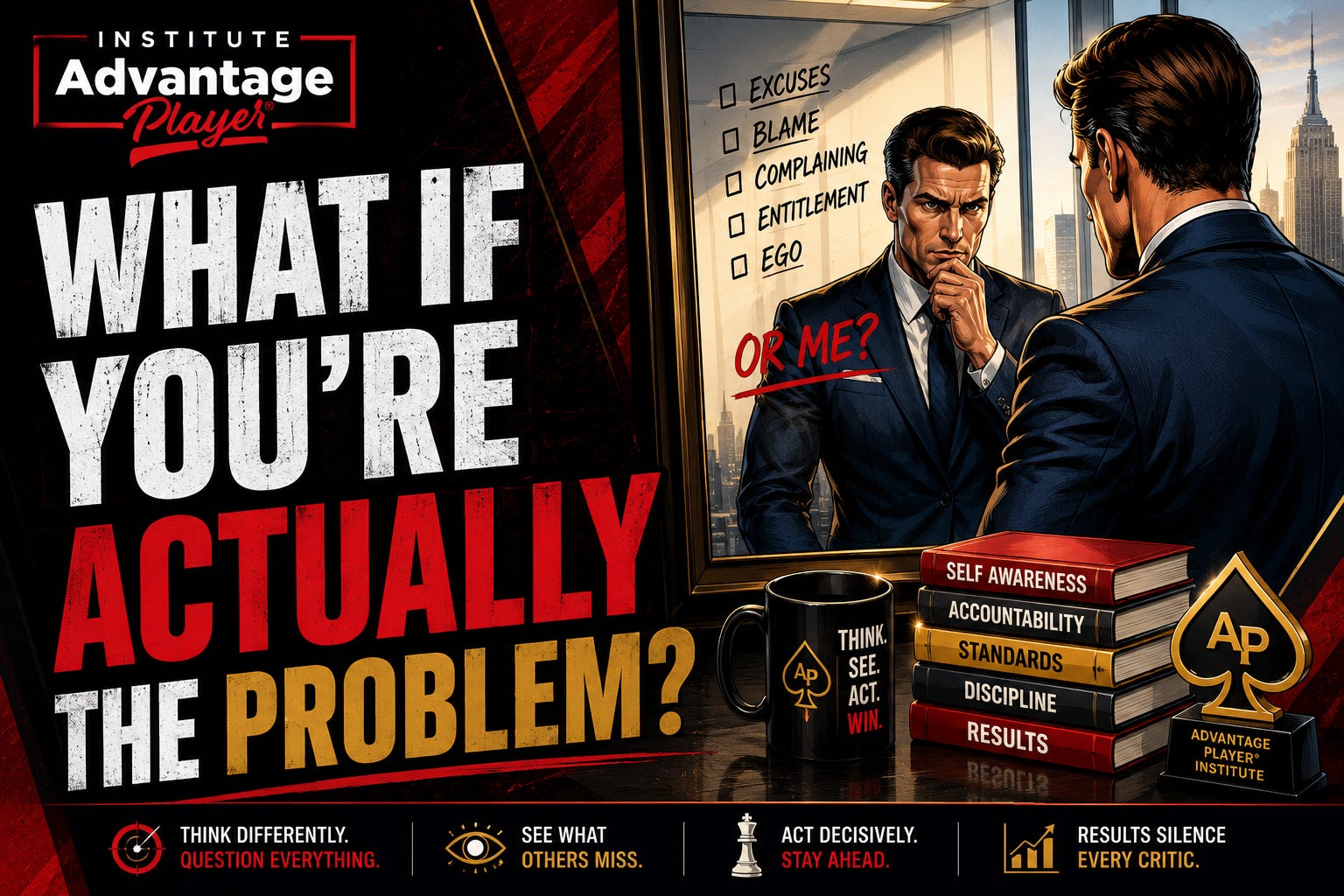
A weak operator protects feelings. A strong operator protects results.
You can learn more from one honest self-assessment than from ten years of excuses. The person who says, “Maybe I wasn’t ready,” becomes dangerous in the best possible sense because now they can improve. The person who blames the world stays trapped in place, waiting for fairness to rescue them.
In business, nobody owes you a seat at the table. The market rewards capability, judgment, consistency, and trust. Sometimes the other candidate simply had more horsepower. Better communication. Better timing. Better presence under pressure. Better command of the room.
That realization stings for about five minutes.
Then it becomes liberating.
“Personal accountability is the closest thing business has to compound interest.”
Once you stop wasting energy defending your ego, you redirect that energy into building advantages. You ask higher quality questions. You study your misses. You become harder to beat. The people winning at the highest levels are constantly auditing themselves. They review bad meetings, lost deals, failed pitches, and weak performances with surgical precision. They keep getting better.
And that is why they keep advancing while others stay stuck in emotional quicksand.
An Advantage Player® understands that excuses create blind spots. TSA - people who think, see, and act differently notice patterns others miss. They know that rejection often contains intelligence. Hidden inside every loss is valuable information about positioning, preparation, confidence, or competence.
A former CEO client once lost a major acquisition opportunity he desperately wanted. Instead of blaming the board, the economy, or politics, he asked one brutal question: “Why did they trust the other side more than me?” That question changed his career. Two years later, he came back stronger, sharper, and wealthier because he fixed the real problem instead of protecting his pride. Most people hearing that story wish they had the courage to do the same.
“Excuses protect your pride while quietly destroying your future.”
The people dominating industries are rarely obsessed with fairness. They are obsessed with readiness.
That is the art of winning.
We are igniting a movement built for leaders who refuse to drift into mediocrity. Leaders who know success is calculated, not accidental. Leaders who understand that high limit moves start with radical self honesty.
Professional blackjack players don’t blame the cards. He studies the deck and trusts the math. Being ready works.
The mirror is uncomfortable for a reason. It reveals the leverage point. The great Michael Jackson told us that in his 1988 classic.
What if the thing holding your company back is the story you keep telling yourself?
Stack the Deck
Every one of these Winning Hands™ reports exposes an Advantage Play® - a killer strategy, that few leaders will say out loud, to shift leverage to those who think differently, see what others miss, and act decisively.
That’s what I do with CEOs and senior operators through keynotes, retreat facilitation, and precision engineering sessions. Not motivation. Not theory. Real-world strategy built from 40 years of buying, selling, investing, raising capital, operating, and doing deals in the middle market.
If you’re hosting a leadership or strategy event in 2026, bring me in. My keynote is not fluffy “inspiration.” It’s a reset. People leave sharper, faster, and in a position to win.
Or book a free 30-minute strategy call. No obligation. Serious upside. Schedule here: https://my.timetrade.com/book/FGJGQ
One of the hidden dynamics here is that excuses often aren’t really about avoiding responsibility—they're about protecting ourselves from discomfort. Fear has a way of disguising itself as an external explanation: unfair timing, unfortunate luck, difficult people, flawed systems.
The mirror becomes valuable because it helps expose what’s underneath the story we’re telling ourselves. Not so we can blame ourselves for everything, but so we can identify where our leverage actually is. The leaders I’ve seen grow fastest aren’t the ones who avoid mistakes; they’re the ones willing to ask, “What am I afraid to see here?”
That question tends to reveal more than ten explanations ever will.